April 9, 2002
SALT LAKE CITY -
Complete Release in PDF Format

 Download Free Acrobat Reader
QUICKLY
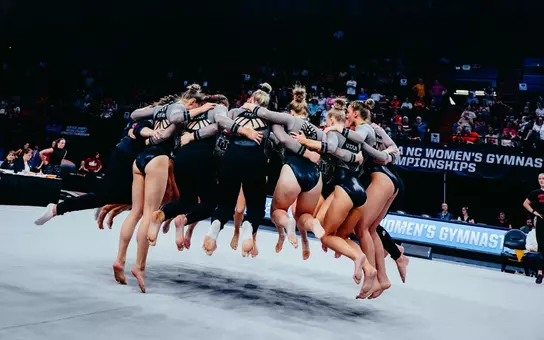
The 10-time national champion Utah gymnasts are headed to their 27th straight national championship after winning the NCAA West Region Championship in Corvallis, Ore. ... The 2002 NCAA Championships will be held in Tuscaloosa, Ala., April 18-20 ... Utah is the only team to make all 21 NCAA Championships to date ...The 12 teams that have qualified for the NCAA Championships are Utah, Georgia, Nebraska, Michigan, Arizona, Alabama, UCLA, Stanford, Louisiana State, Oregon State, Florida and Minnesota ... The Utes will open NCAA competition on April 18 at 1:00 p.m. (CDT) in Alabama's Coleman Coliseum ... There are two qualifying sessions on Thur., Apr. 18, each containing six teams. The top three teams from each session will advance to the Super Six finals on Fri., April 19 ... The individual event championships are April 20.
LIVE SCORING ON THE NET
Live scoring from the NCAA Championships will be available on the Internet. To follow the meet in progress, log on to www.rolltide.com.
SUPER SESSION
The afternoon qualifying session on April 18, of which Utah is a part, features four Super Six teams from a year ago, meaning at least one team will not return to the championship finals. The evening session has the remaining two 2001 Super Six finalists (UCLA and Alabama). Super Six returners in the afternoon session are Utah, Georgia, Michigan and Nebraska. By final national ranking, here's how both sessions look:
Session I:
No. 3 Georgia, No. 4 Utah, No. 5 Michigan, No. 6 LSU, No. 8 Nebraska, No. 12 Arizona.
Session II:
No. 1 UCLA, No. 2 Alabama, No. 10 Stanford, No. 11 Minnesota, No. 13 Oregon State, No. 15 Florida.
UTAH IN THE POSTSEASON
Utah has qualified for nationals every year since becoming a varsity program back in the 1975-76 season. The Utes, under head coach Greg Marsden, have won a record 10 national championships (nine NCAA titles). Utah is 377-64-3 all-time in postseason competition.
SHE IS THE CHAMPION
Junior Theresa Kulikowski, a three-time NCAA champion and two-time NCAA runner-up at her first two national championships, will finally have another shot at the all-around title she won as a freshman in 1999. Kulikowski won the all-around and balance beam titles that year, while placing second on floor and vault. After missing the 2000 season with a torn ACL, Kulio came back on two events as a sophomore last year, winning another NCAA beam title and finishing third on bars. This Feb. 15, Kulikowski returned to the all-around lineup for the first time in over two years and scored a career-high 39.80. She has won five of her six all-around attempts this season, including the NCAA West Region, and has scored a career-high 39.80 twice. Kulikowski took the NCAA regional all-around title with 39.675. She also won the region uneven bars (9.95) and balance beam (10.0) titles. Her perfect score on beam was the only 10.0 awarded in Corvallis that night.
SEEING STARS
Senior Deidra Graham, a six-time All-American, is the two-time North Central Region Gymnast of the Year (2000-01). Graham was Utah's top all-arounder at the last two NCAA Championships, finishing eighth last year and 10th the year before. Senior Shannon Bowles, a six-time All-American and the 2002 North Central Region Gymnast of the Year, has won All-America honors in the all-around and on floor, beam and bars. Sophomore Melissa Vituj was a three-time All-American as a rookie last year. Vituj made beam and floor finals, finishing third and ninth, respectively. She was a second-team All-American on vault.
UTAH IN THE RANKINGS
Utah was ranked No. 1 two times (Jan. 28 and Feb. 1) and finished the regular season at No. 4. The Utes were ranked fifth in the preseason poll, which was their lowest ranking of the year. For the second straight year, Utah was the nation's top-ranked beam team, edging UCLA 49.380-49.305 in final regional qualifying score (RQS). The Utes finished the regular season ranked fourth on both bars (49.290) and floor (49.420) and sixth on vault (49.270). Theresa Kulikowski, a two-time NCAA beam champion, won the regular season beam title (9.960 RQS) for the second straight year. She was third on bars (9.945) and seventh on floor (9.935). Shannon Bowles finished third on beam in the final rankings (9.945 RQS).
UTE NOTES
Junior All-American Theresa Kulikowski is Utah's 2002 win leader with 28. In two and a partial (2001) seasons, Kulikowski has 95 career victories (all-around and individual events), which places her in the top three all-time at Utah ... Kulikowski won 5 of her 6 all-around appearances but did not compete in the all-around enough to have a regional qualifying score ... Freshman Annabeth Eberle won the NCAA West Region vault title with a career-best 9.925. Eberle was Utah's second-best all-around finisher at regionals, tying for sixth with a career-best 39.325 ... Two-time first-team All-America all-arounder Deidra Graham is back in the all-around lineup after doing just bars for five weeks due to bulging disks in her back ... Five different Utes have won all-around titles this year: Shannon Bowles vs. Ohio State, Washington and Florida, Melissa Vituj vs. Arizona, Graham vs. Minnesota, Veronique Leclerc vs. LSU and Kulikowski vs. Utah State, BYU (twice), Oregon State and NCAA regionals.
TINY TEAM
Utah has just eight gymnasts available for the NCAA Championships and all of them competed at the regional meet-four in the all-around. Senior Kylee Wagner, a three-event performer and 2001 NCAA beam All-American, has been out since the first meet with an ankle injury. She will apply for a medical hardship waiver. Sophomore Annie Medcalf, who had made the lineup on bars and beam, won't be with the team at nationals. She is back in her home state of Ohio awaiting surgery to remove a tumor from her vertebrae. Freshman Gritt Hofmann will seek a medical extension for a back injury.
REGION RECAP
Junior Theresa Kulikowski won the all-around (39.675), uneven bars (9.95) and balance beam (10.0) to lead Utah to victory at the balanced NCAA West Region championships. Utah, which hit 22 of 24 routines and did not have to count a fall, held off Oregon State (196.80) and Oklahoma (196.625) for the win. Freshman Annabeth Eberle was Utah's other winner. Eberle, who tied for sixth in the all-around (39.325), won vault with a 9.925. Sophomore Melissa Vituj went 39.30 in the all-around to finish eighth.
UTAH COACH GREG MARSDEN
Greg Marsden, the most successful coach in collegiate gymnastics history, is in his 27th year at the U. He is college gymnastics' only 700 win coach (757-115-5). In regular season competition, Marsden is 380-51-2. He has spent his entire career at Utah and has won 10 national championships, double that of any other coach. Four of those titles came in the '90s (1990, '92, '94, '95). Fifteen of his teams have placed in the top-three at the national championships, most recently in 2000 (second). Marsden is a seven-time National Coach of the Year recipient.
UTAH'S ROTATION
A blind draw determines how the teams rotate on the two nights of team competition at the NCAA Championships. Utah's order of rotation will be: bye, floor, vault, bye, bars, beam.
VETERAN FIELD
Every team to qualify for the 2002 NCAA Championships has been there before. The teams headed to Tuscaloosa and the number of NCAA Championship appearances this makes for them follow: Utah (21), Alabama (20), Florida (20), Georgia (19), UCLA (19), Oregon State (16), Nebraska (13), LSU (13), Arizona (10), Michigan (11), Stanford (5), Minnesota (2).
UTAH AND THE SUPER SIX
Utah has made the Super Six seven times since the format went into effect in 1993. Utah's Super Six finishes follow: 1993-3rd, 1994-1st, 1995-1st, 1996-3rd (tie), 1998-4th, 2000-2nd, 2001-5th (tie). The Utes failed to make the cut in 1997 and 1999, finishing seventh both years. Although they have won two NCAA Championships under the Super Six format, the Utes have never won a qualifying round.
HISTORY LESSON
Four teams have been crowned champion in the 20-year history of the NCAA Women's Gymnastics Championships: Utah (9), Georgia (5), Alabama (3) and UCLA (3). Utah's 10 total national championships includes the 1981 AIAW title ... There have been eight different runners-up at the NCAA Championships since they began in 1982: Alabama (5), Utah (4), Arizona State (4), Georgia (2), UCLA (2), Florida (1), Michigan (1) and Cal State-Fullerton (1) ... The closest NCAA Championships ever were in 1994 and 1989. In 1994, Utah edged Alabama 196.400-196.350. In 1989, Georgia nipped runner-up UCLA 192.650-192.600 ... The best score ever at nationals was Alabama's 198.025 in 1996 ... The NCAA champion has won its qualifying session six times in the nine-year history of the three-day format: Georgia in 1993, 1998 and 1999, Alabama in 1996 and UCLA in 2000 and 2001 ... Utah won the NCAA title in 1994 and 1995, after finishing second and third, respectively, in its qualifying round. UCLA won in 1997 after placing second in its qualifying round.
MARSDEN SAYS
"We seem to be on a roll right now after struggling in the middle part of the season with consistency. Everyone now seems to be much more relaxed and competing with a lot of confidence. I think we're as healthy as a team as you can expect to be at this point in the season. "It really says something about how far women's gymnastics has come when you look at the results from regionals and see how many teams had a legitimate chance to qualify to championships. More and more teams are becoming competitive and it has become increasingly difficult to qualify to championships. "With that said, it is even that much more difficult to make it into the Super Six. It appears to me that anyone who competes well and hits their routines has a chance to advance. The luck of the draw put four teams from last year's Super Six in our session. Each year it works out that one session is a little harder to get out of than the other. The reality is that it all has to come together and your team has to be hot that weekend anyway so you can't worry too much about who else is in your session. Instead, you have to focus on just doing your job. "Alabama always hosts a great event and their fans are among the best in college gymnastics. There's no question they will run a great championship and this will be an exciting event for the athletes."
FAN FAVORITE
Utah, the highest drawing gymnastics team in NCAA history, won its 19th attendance crown in the last 21 years in 2002. The Utes averaged 9,921 fans to their six home meets, led by a crowd of 14,285 for their regular season finale vs. BYU. Since 1992, Utah's regular season home attendance has never dipped below 9,500 and its 10-year average is over 10,000 fans per meet. That is more than any other gymnastics team has averaged in a single season. Utah holds the record for the top five season attendance averages ever by a gymnastics program, including a single-season best 13,164 in 1993. Utah also has nine of the top 10 single meet attendance records. The Utes hosted the largest crowd ever to watch a collegiate gymnastics meet in the United States-15,238 vs. Cal State Fullerton in 1991.
A LEAGUE OF THEIR OWN
Utah is the only gymnastics program in the nation to qualify for every national championship since it became a varsity sport back in 1975-76. The Utes have qualified for 27 straight national meets and are the only program to qualify for all 21 NCAA Championships. Utah has won a record 10 national championships (1981-86, 1990, 1992 and 1994-95). The Utes have never finished lower than 10th in the nation.