April 2, 2003
SALT LAKE CITY -
Complete Release in PDF Format

 Download Free Acrobat Reader
QUICKLY
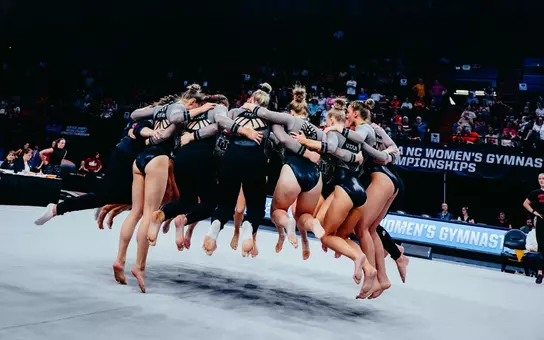
The No. 8 ranked Utah gymnasts will host the NCAA North Central Region Championship in Salt Lake City on Saturday, April 12 starting at 6:00 p.m. (MDT) in the Huntsman Center ... The six teams to qualify for the North Central Regional are: No. 6 Stanford, No. 8 Utah, No. 18 California, No. 20 Brigham Young, No. 21 Denver and No. 23 Minnesota ... Four at-large all-arounders and four individual event specialists will also compete ... The top two teams at regionals will automatically qualify for the NCAA Championships in Lincoln, Neb., April 24-26 ... Utah is the only team in the nation to qualify for all 21 NCAA Championships and for the last 27 national championships including the AIAW years.
TICKET TALK
Tickets for the NCAA Regional Championships may be purchased by calling the Ute ticket office at 801-581-UTIX or online at www.UtahUtes.com. Ticket prices range from $3-$13. Adult reserved is $10 and $13, youth reserved is $8, family reserved is $5, adult general admission is $4 and youth general admission is $3.
PUBLIC PRACTICE
All six teams and at-large competitors will participate in a mandatory practice session in the Huntsman Center on Friday, April 11. There are two practice sessions and both are open to the public, free of charge. Athletes and coaches will be available for media interviews during their respective sessions. Friday's practice schedule, by team, follows: 2:00-3:40 p.m. California, Minnesota, Stanford. 4:00-5:40 p.m. BYU, Denver, Utah.
OTHER UTE PRACTICES
March 31-April 4: Monday, Tuesday, Thursday and Friday (1:30-5:00 p.m.) in the Dumke Gymnastics Center. April 7-11: Monday, Tuesday and Thursday (1:30-5:00 p.m.) in the Dumke Center; Friday (4:00-5:40 p.m.) in the Huntsman Center. All practices are open. Media interested in interviews on practice days other than April 11 should plan to be in the Dumke Gymnastics Center 30 minutes before practice begins. All athlete interviews must be completed by the start of practice with the exception of April 11. Call sports information director
Liz Abel at 801-581-3511 to arrange interviews.
UTES BEAM OVER ROTATION
As was the case for the entire 2002 postseason, Utah will conclude its 2003 regional competition on the balance beam. The NCAA conducts a random draw to determine each team's rotation in the postseason. Last year, Utah drew the balance beam as its last event in regionals, the first round of nationals and the NCAA Super Six. It proved a great rotation for the Utes, who won regionals and their first session at the NCAA Championships, then finished fourth in team finals. At the upcoming regional, Utah's order of competition will be: floor, vault, bye, bars, beam, bye.
KULIO QUESTIONABLE
The status of senior All-American Theresa Kulikowski for regionals is questionable. The 12-time All-American and 1999 NCAA all-around champion has missed five meets this year due to a dislocated rib, broken finger and illness. Utah hopes to have Kulikowski available on both the balance beam (where she is a two-time NCAA Champion) and the uneven bars for the postseason. When she has competed, she has been marvelous. She has won all six of her bar competitions, an event in which she is currently ranked fourth nationally, has a 10.0 on both bars and beam, and has won 10 of her 16 total routines.
REGIONAL TRIVIA
Utah has won three straight regional titles, winning the 1999 and 2001 North Central championships and placing first at the West Regional last year ... This marks the 28th-consecutive regional appearance for the Utes, who have qualified for regionals and nationals every year since becoming a varsity program back in the 1975-76 season ... Utah has won 20 regional titles (18 NCAA) and finished second in its region the other seven times (4 NCAA) ... Utah is 8-0 in NCAA regional meets held in Salt Lake City, the most recent in 2001 ... 18 teams were seeded into regionals. Each region contains three seeded teams.
THE ROAD TO REGIONALS
Thirty-six teams qualified into the regional championships by their regional qualifying score (RQS), which is determined as follows: Take the six best regular season scores, three of which must have come on the road, drop the high score and then average the remaining five scores. Each of the six regional sites contains three seeded teams. All host teams stayed at home to compete, regardless of seed.
NCAA REGIONAL SITES
The region championships will be held on Sat., Apr. 12 at six sites around the country. The start time will be 6:00 p.m. local time at all sites except Seattle (5:00 p.m. PDT). The sites and hosts are: West Region-Seattle; North Central Region-Salt Lake City; South Central Region-Columbia, Mo.; Central Region-Tuscaloosa, Ala.; Northeast Region-Ann Arbor, Mich.; Southeast Region-Athens, Ga.
FINAL NATIONAL RANKINGS
Utah finished No. 8 in the final national rankings, issued March 31. The rankings, which are based on regional qualifying score, follow: 1. UCLA 197.980, 2. Nebraska 197.585, 3. Arizona State 197.490, 4. Georgia 197.485, 5. Alabama 197.345, 6. Stanford 197.300, 7. Oklahoma 197.250, 8. Utah 197.180, 9. Florida 197.010, 10. Michigan 196.895, 11. Washington 196.715, 12. Oregon State 196.665, 13. Iowa 196.515, 14. Louisiana State 196.485, 15. Iowa State 196.460, 16. Ohio State 196.355, 17. Auburn 196.350, 18. California 196.160, 19. Arizona 196.100, 20. Brigham Young 196.075, 21. (tie) Denver, Kent State 196.035, 23. Minnesota 195.960, 24. North Carolina State 195.930, 25. Central Michigan 195.780.
GETTING TO NATIONALS
The top two teams from each region will automatically qualify for the 2003 NCAA Championships, regardless of their scores. The 2003 NCAA Championships will be hosted by the University of Nebraska in Lincoln, Neb., on April 24-26. Once the national championships field has been determined, a random draw will place the teams into the two preliminary sessions on April 24. Half of the winning teams from regionals will draw the afternoon session and half the evening session. The same procedure will be followed for the second-place teams. The group with Nebraska will automatically be placed in the evening session.
LAST UTE ACTION
Utah sizzled on its first three events and ran up a two-point lead over rival Brigham Young in Provo on Mar. 28 before settling for a 197.400-196.025 victory after running into trouble on the beam. Despite counting a fall and some deductions for balance checks on the beam, the Utes' 197.400 score was the 10th best in school history. Sophomore Annabeth Eberle won the all-around with a career-best 39.75 (tied for the fourth-best mark in school history) and junior Melissa Vituj finished second with a 39.625 to lead the Utes. Eberle also won floor with a 10.0 and vault with a 9.95, while Vituj took first on beam (9.90). Senior Kim Allan won bars with a 9.95.
UTE INDIVIDUALS ARE RANKED
Four Utes were listed in the final national rankings, led by Melissa Vituj and Annabeth Eberle in multiple events. Vituj is No. 5 in the all-around with a 39.605 all-around regional qualifying score (RQS), while Eberle is tied for No. 7 (39.585). The two are tied for sixth on floor exercise with a 9.955 RQS, Vituj is tied for fifth on beam (9.945) and Eberle is tied for seventh on vault (9.940) and is 11th on beam (9.920). Representing Utah in the top 10 on bars are Theresa Kulikowski (4th, tie, 9.935) and Kim Allan (8th, tie, 9.930).
UTE NOTES
Utah finished the regular season with a 7-5 record. Four of those losses were to top 10 schools (UCLA, Arizona State, Florida and Michigan) ... The Utes were better on the road (4-2) than at home (3-3) for the first time in school history ... The status of Theresa Kulikowski will determine Utah's bar and beam lineup for regionals. If Kulikowski is healthy, she will compete as Utah's final competitor on both events. If she cannot compete, Kristen Riffanacht and Kylee Wagner will complete the bar and beam lineups ... Utah's victory leader is Melissa Vituj (20), followed by Annabeth Eberle (18) ... The two best all-around scores of the year are by Eberle (39.750) and Vituj (39.675 twice).
UTAH COACH GREG MARSDEN
Greg Marsden, the most successful coach in collegiate gymnastics history, is in his 28th year at the U. He is college gymnastics' only 700 win coach (771-124-5). In regular season competition, Marsden is 385-56-2. He has spent his entire career at Utah and has won 10 national championships, double that of any other coach. Four of those titles came in the '90s (1990, '92, '94, '95). Fifteen of his teams have placed in the top-three at the national championships, most recently in 2000 (second). Marsden is a seven-time National Coach of the Year recipient.
MARSDEN SAYS "As usual, this will be one of the toughest regions to get out of because of how strong our geographical region is from top to bottom. We're going to have Stanford and Cal, but we'll also have the No. 20, 21 and 23 teams here, which are all good teams and are capable of getting hot and putting pressure on the higher seeds. "Scores have been very competitive throughout the country in recent weeks, with very few teams from the major conferences missing routines. College gymnastics has really gotten to the point where there are a lot of teams capable of moving on to the championships. A team is going to have to be peaking now if it expects to be successful. It appears like a lot of teams are doing that. "Other than the obvious mistakes on balance beam, I was really pleased with our progress (in Utah's final regular season meet) at BYU. We need to stay focused in practice and continue to improve. In the practices leading up to regionals, we'll be working to correct a lot of the little things: hitting landings, eliminating balance checks and foot faults and hitting handstands."